Your Agents Don't Need an Org Chart
August 12, 2026
A few weeks ago a founder friend sent me a message. He’s technical, thoughtful, and deep into agents. Here’s the gist:
“What would solve everything for me is a team of coding agents — a strategist, a builder, a checker. I give them wireframes and a PRD, and they code autonomously, find bugs, and improve the product until it reaches its final stage. I’m trying to make agents work for days without me. It’s not happening.”
He had built the whole thing properly. An orchestrator agent managing multiple coding sessions. A messaging layer so the agents could talk to each other. A shared task list tracking every feature and bug. None of the plumbing was the problem — every piece worked as designed.
And the system still didn’t converge.
I’ve now seen this architecture enough times to recognize it as the default. It is the most natural idea in agent engineering: build a company out of agents. A designer agent, a CTO agent, engineer agents who own features, a PM agent who makes the calls. Draw the org chart, wire up the messaging, press go. The people building these systems aren’t being naive — the org chart is the most successful pattern humans have ever found for coordinating intelligence. Reaching for it is the reasonable move.
I would argue it’s the wrong one, and the reasons turn out to be more interesting than “multi-agent bad.” The short version: the org chart copies the wrong thing about how humans work, and 2026 is the year the evidence came in. Let me walk through it.
It’s worth pausing first on how Anthropic treats this architecture, because they’ve shipped it. Agent Teams in Claude Code is my friend’s system as a first-party product: a team lead, teammate sessions with their own context windows, a mailbox so agents can message each other, a shared task list with ownership and dependencies.
Now read the guidance that ships with it:
“For sequential tasks, same-file edits, or work with many dependencies, a single session or subagents are more effective.”
And:
“Start with tasks that have clear boundaries and don’t require writing code… Letting a team run unattended for too long increases the risk of wasted effort.”
Building a product from a PRD is about as sequential, same-file, and dependency-heavy as work gets. In other words: the team that built the feature is telling you, in its own manual, that the feature is the wrong tool for exactly the job most people want it for. It ships off by default, behind an environment variable, at roughly 7x the tokens of a single session.
That should make us curious rather than dismissive. If the org chart keeps failing at this, why does it fail? To answer that, you have to ask why org charts exist at all.
Human teams need different roles for two reasons. Both are biological.
The first is that humans genuinely have different skills. A great designer takes ten years to make. So does a great backend engineer — a different ten years. You can’t merge them into one person. The org chart exists to route work to skill that is scarce and can’t be copied.
The second is that human brains can’t share memory. I can’t give you my context. I can only compress it into words — meetings, documents, chat messages — and you decompress it on your end. Some of it is always lost. Most of what we call management is a workaround for the fact that knowledge is stuck inside individual skulls.
Now look at an agent team through that lens. Every agent is the same model: same weights, same training, same skills. The “senior architect” and the “junior developer” differ by a paragraph of system prompt. And unlike humans, agents could share memory perfectly — context is just tokens — except the org chart is exactly the structure that stops them. You take one brain, split it into seven processes, and make them talk through chat messages like colleagues in an office. Biology forces that lossy channel on humans. The org chart forces it on agents by choice.
One Reddit post-mortem — an agency owner who eventually tore down his crew system — described where this leads. His planner spent 55 minutes waiting on his researcher, which was waiting on scope from the planner. Nothing crashed; every component worked as designed. “The system had a meeting and the meeting never ended.” His conclusion is hard to improve on: “We spent two decades flattening management layers, then turned around and reinstalled them as software… It looks like an org chart because it is one.”
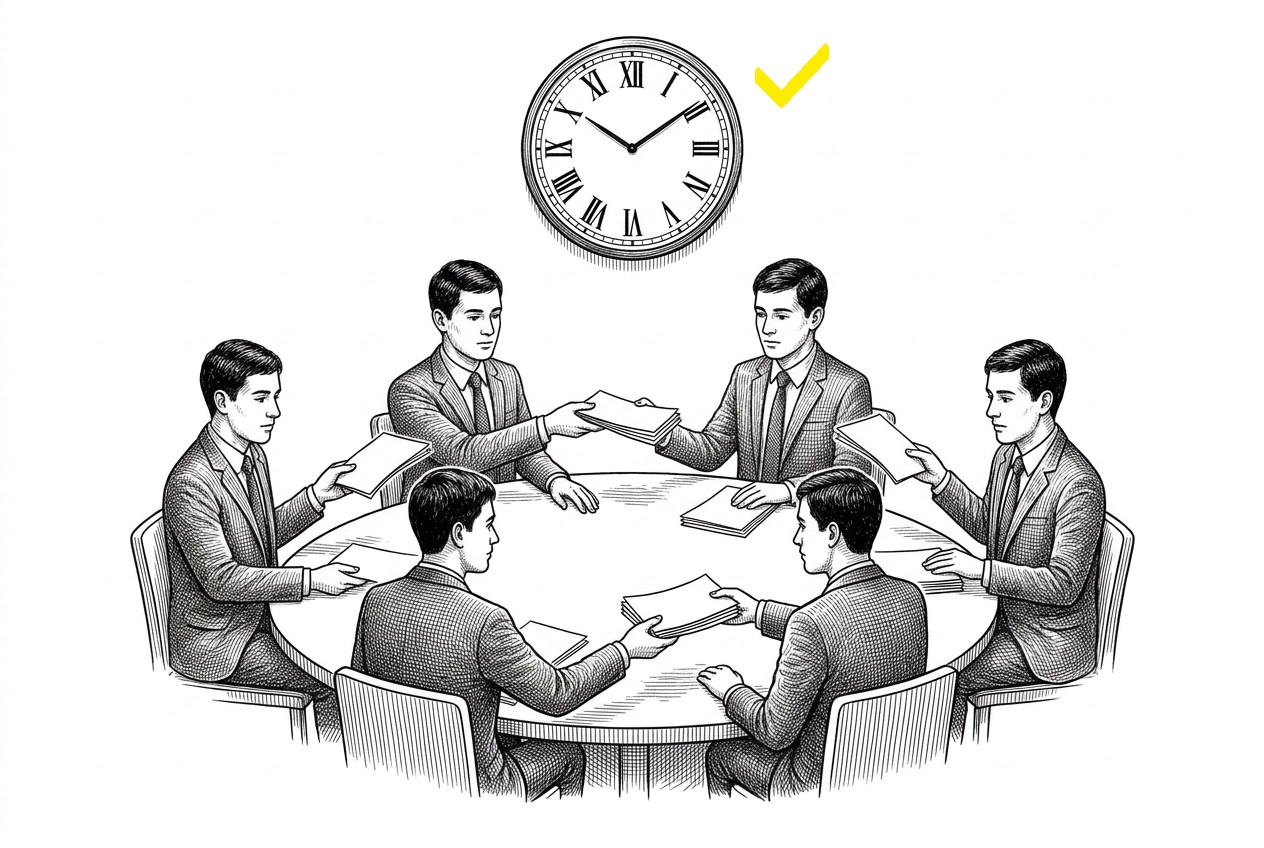
Anecdotes are easy to trade. What convinced me is the measured evidence. It was collected by people on both sides of this argument, and it keeps pointing the same way.
Role personas don’t add capability. The largest direct test — 162 personas across 2,410 questions and four model families — found that adding personas to prompts “does not improve model performance,” and that the effects which do exist are “largely random”: you can’t even pick the good persona better than chance. Meanwhile, the one multi-agent gain that replicates cleanly — the “More Agents Is All You Need” result — comes from identical agents voting on answers, with no roles at all. Even there, a single call to a stronger model beat forty copies of a weaker one on every benchmark tested.
Agents play their roles fine, and the systems fail anyway. This is the finding I’d most want an org-chart builder to sit with. The Berkeley MAST study annotated 1,642 execution traces across seven multi-agent frameworks and found failure rates between 41% and 87%. But “disobey role specification” accounted for under 2% of those failures — nearly the lowest of all fourteen failure modes they catalogued. The agents stay in character. The systems die of coordination breakdowns, premature termination, and missing verification. The costume works; the company doesn’t. Which tells you the role layer was never where the problem lived.
The theory now exists. A 2026 paper proved what practitioners kept rediscovering: if agents could share context freely, one agent could do anything a team of them can. A multi-agent system is just a single agent with a lossy channel cut into it — every hop loses a little, and all the strange behavior lives in that loss. The same paper found the gains from splitting shrink, and sometimes reverse, as models get stronger. That fits a simple explanation: splitting was covering for weak models. Strong models don’t need the cover.
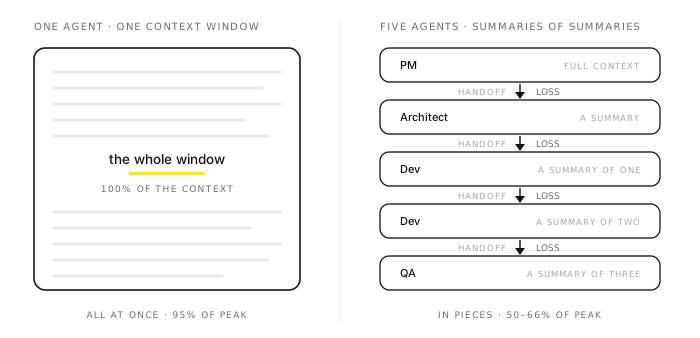
And the loss has been measured. The best experiment on this — 200,000+ simulated conversations by Microsoft and Salesforce researchers — found that if you give a model all the information at once, it performs at about 95% of its best. Feed it the same information in pieces — which is what every agent-to-agent handoff does — and it drops to 50–66%, and becomes more than twice as unreliable. Same facts, arranged differently, a third of the reliability. Every relay in an agent team is a summary of a summary; this is the price of each hop.
The economics follow the same pattern. A Princeton study found a celebrated agent architecture cost 54.9x more than a trivial retry baseline and scored five points worse. The largest agent-evaluation study to date — 21,730 rollouts — found the most expensive configuration was on the cost-quality frontier in only one of nine benchmarks. The top of SWE-bench Verified, the standard benchmark for real software fixes, is held by single-agent scaffolds; one of the best is about a hundred lines of Python and a bash tool. And one practitioner who measured his own agent chains found roughly half of all tokens were spent re-explaining things the system already knew. Another practitioner put the whole economics in one sentence: delegation doesn’t save tokens, it moves context around.
If you’ve run agents seriously, you have an objection ready: the reviewer agent works. A checker that inspects the builder’s code genuinely catches real bugs. I agree — and I think the reason it works is the most telling fact in this whole debate.
The team behind Devin wrote the original argument against this architecture in 2025 — “Don’t Build Multi-Agents”. In April 2026 they published a follow-up, “Multi-Agents: What’s Actually Working”, reporting the narrow class of patterns that had earned their keep in production. Their flagship is a code-review agent, and their headline observation about it is this:
“We found this technique to work best when the coding and review agents do not share any context beforehand.”
The one role that reliably works, works by knowing less. A checker that inherits the builder’s reasoning inherits the builder’s blind spots, and tends to approve what the builder has already talked itself into. A checker that sees only the diff and the spec catches what the polluted context can’t. Their explanation is worth quoting because it rejects the human comparison outright: same-model agents “don’t have egos” — the reviewer isn’t a different person with different incentives, it’s the same brain with a shorter, cleaner context, and “having a clean context makes the agent smarter because of the math of attention.”
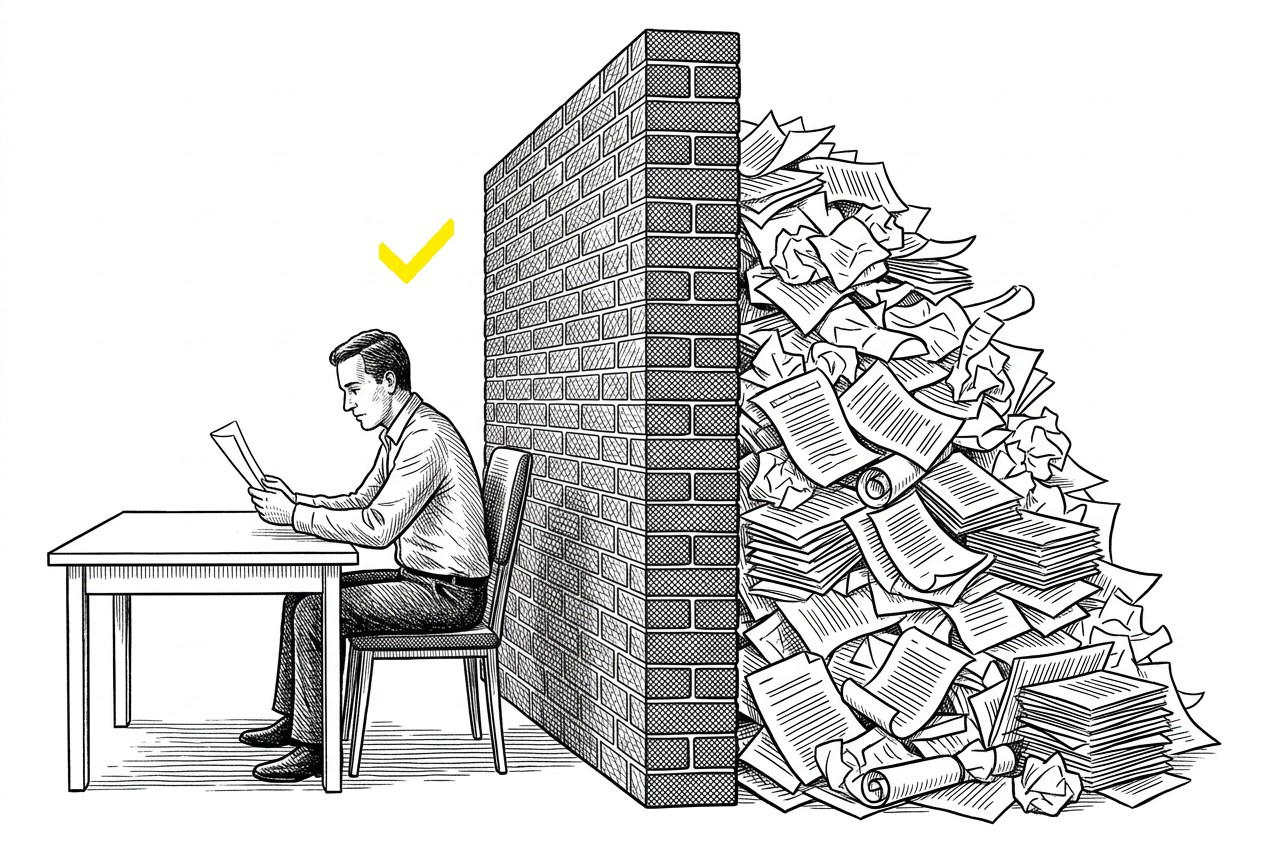
So the working QA agent is not evidence for the org chart. It’s a context-engineering technique that happens to be wearing a job title. The value doesn’t come from the role; it comes from deliberately deciding what the second context contains — and, just as deliberately, what it doesn’t.
One honest footnote: several practitioners report that review by a different vendor’s model catches more than same-model review, because different models genuinely have different blind spots. That’s the one place skill differentiation returns — and note what it took: an actually different brain, not a different prompt.
What persuades me most is that both camps — the multi-agent optimists and the skeptics — landed on the same shape during 2026, in nearly the same words. Cognition’s version: multi-agent systems work best “when writes stay single-threaded and the additional agents contribute intelligence rather than actions.” A solo SaaS founder on Reddit, arriving independently: parallel work is subagents doing research and review, with one writer on the checkout.
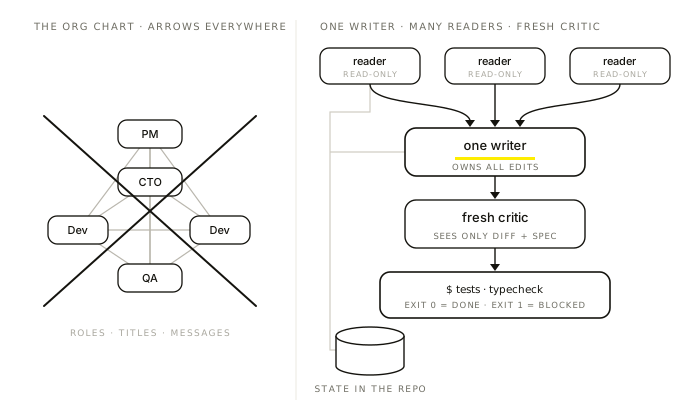
I’d summarize the converged shape as: one writer, many readers, and a critic who never saw the reasoning.
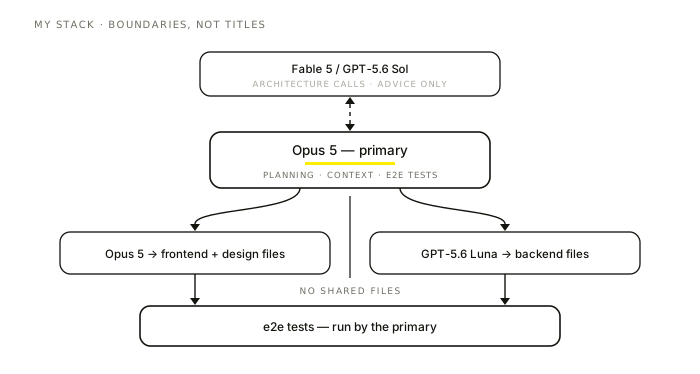
Abstract advice is easy, so here is what I actually run. It’s boring on purpose.
That’s the stack. That’s it — rather than refereeing twenty agents with job titles.
Notice what the “roles” here actually are. The architect is defined by being consulted — intelligence, not actions. The executors are defined by which files they own. Two of the models come from a different vendor, which buys the different-blind-spots benefit for real. Nobody has a title. Everybody has a boundary.
As for my friend: his instinct — spec first, wireframes, PRD — was right, and his plumbing was fine. What was wrong was the shape of the system: who saw what. The unit of agent autonomy in 2026 is not “the product”; it’s one reviewable diff. Nobody with production numbers is shipping whole features autonomously, and Anthropic’s own sizing guidance for an autonomous unit of work is a function or a test file. The realistic win is many short autonomous runs with cheap gates — a human on the plan, a program on the tests, a human on the diff — rather than one long run with none. The missing piece of his system was never another agent. It was a gate.
The frame I’ve landed on is this: every pattern above is an answer to one question, and the question is not “who reports to whom.” It is what does each model call get to see — and what should it never see?
The readers exist to keep exploration out of the writer’s context. The writer is single so decisions pile up in one context instead of being negotiated across seven. The critic works because of what it doesn’t see. The state lives in the repo so any fresh context can rebuild the truth from disk. None of that is an organization. It’s a context topology — a design for who sees what — and drawing it is the real engineering.
I’ll note where this points, because I think the bigger question is hiding underneath. If the hard problem is deciding what each intelligence gets to see, then the scarce asset isn’t the model — everyone has the same models now. It’s the map your context gets drawn from: a structured, current picture of your world that you can actually query. That deserves its own piece, and I’m working on it.
I’m genuinely optimistic about agents collaborating in richer ways over time; the models are improving fast, and some of the coordination failures above will soften. But the pattern of the evidence is hard to ignore: we spent twenty years flattening management layers because the communication overhead was hurting us, and the current fashion is to reinstall them as software, at 7x the tokens. I’d suggest a different default. Give your agents boundaries, not titles — let each one know exactly enough, and nothing more.