Let it tangle early, comb it straight later

June 2, 2026
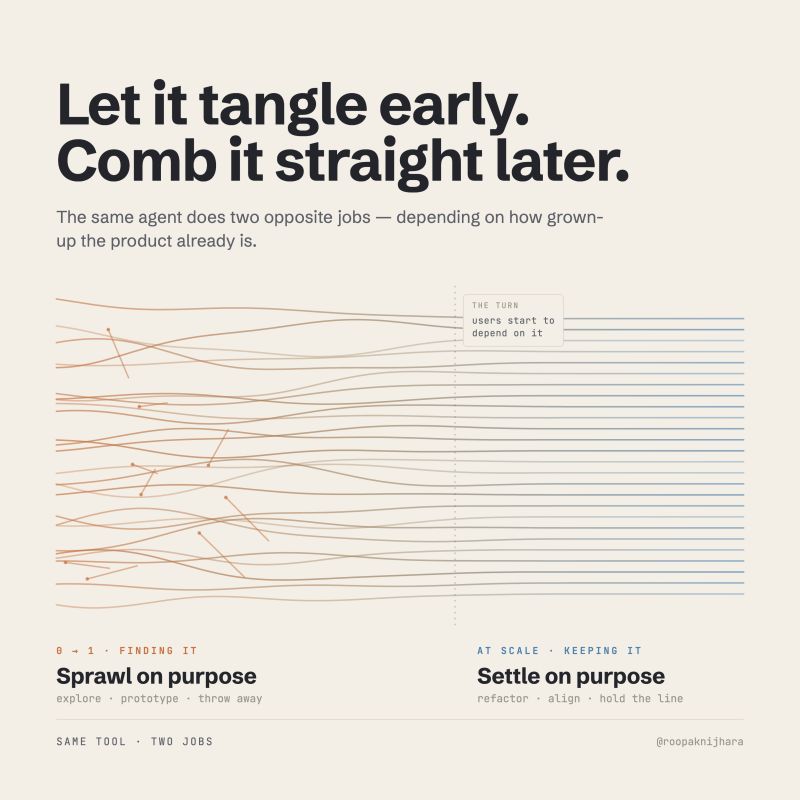
0 to 1 is where agents should go wild. Scale is where they should become boring.
That was my biggest takeaway from Dax Raad’s Pragmatic Engineer interview.
Dax is worth listening to because OpenCode is not a toy project. It went from ~650K monthly active users to heading toward ~8M, with almost 1M daily active users.
And the interesting part is that he is not selling agents as magic. He talks very directly about the cost of building with them.
OpenCode was shipping features it should not have shipped. Absorbing too many hacks. Not cleaning up enough. And according to Dax, they were not even getting dramatically faster in exchange.
That hit close to home.
Agents are incredible.
Use them to prototype. Try strange flows. Build disposable versions. Test ideas before you overthink them.
At that stage, code is a learning tool. The goal is to reduce uncertainty.
The constraint changes. At that point, speed starts creating different problems.
Every change has to fit into real workflows, real expectations, and an existing system.
This is where agent usage has to change.
In the early stage, I want agents generating surface area. In the later stage, I want agents preserving clarity.
Not just more features.
Agents can produce the change. The harder call is whether the product is mature enough to absorb it.
Treat every stage like 0 to 1 and the product slowly turns into something nobody designed.
Fast to build. Hard to understand. Painful to change. Eventually impossible to trust.